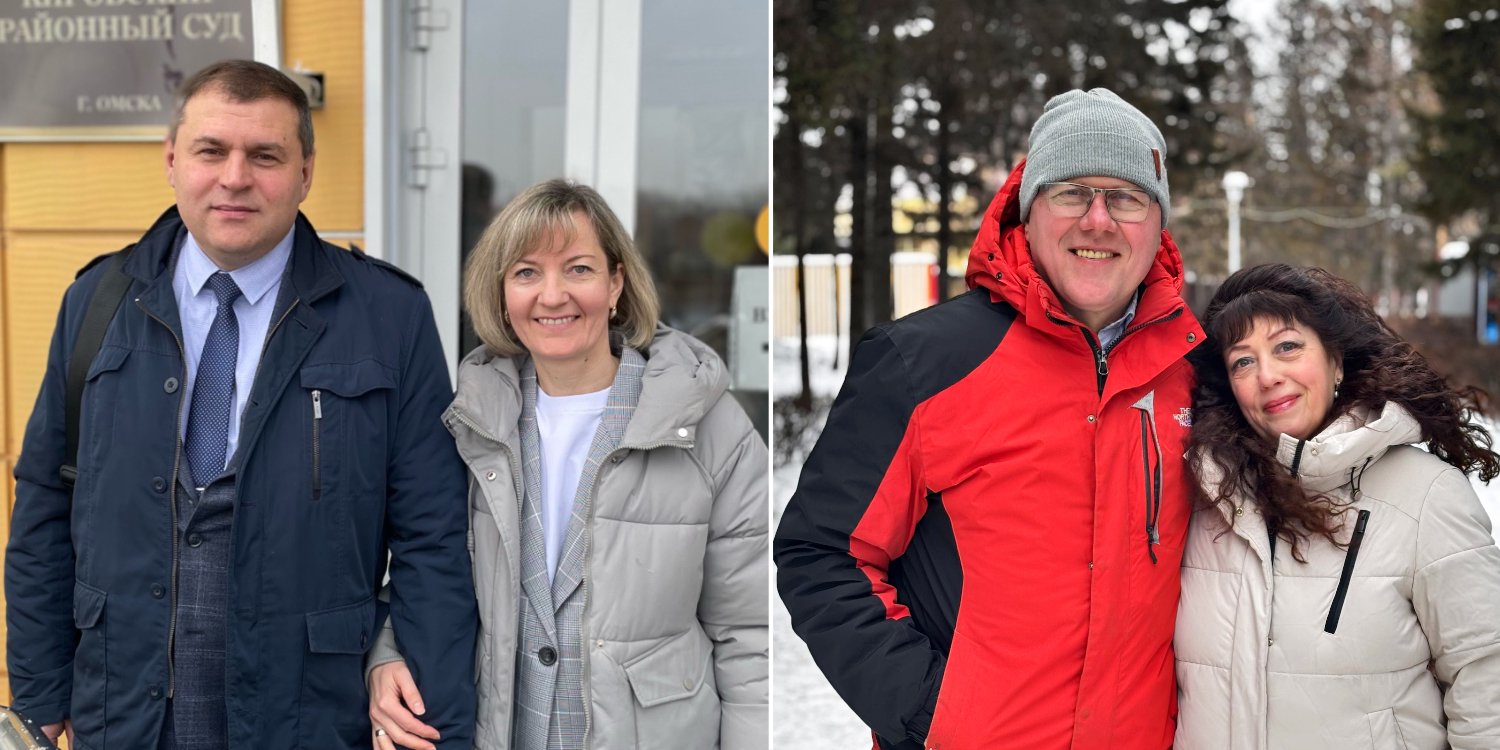
Second Guilty Verdict Against Jehovah’s Witnesses in Omsk Region: Two Men Sentenced to Forced Labor
Omsk RegionOn April 29, 2026 the Kirovskiy District Court of Omsk sentenced Sergey Rygaev and Leonid Pyzhov to 3 years and 3.5 years forced labor, respectively. Judge Aleksandr Borodin deemed their meetings with friends to read the Bible and their faith in Jehovah God extremist activity.
Both believers have vocational training in construction. Sergey is a tinsmith — a rare trade — and a recipient of the "Honorary Worker of the Oil and Gas Equipment Industry" award. Leonid is a mechanic; before his arrest, he worked as a driver for a social-service taxi and managed a goods pick-up point. Both men have families; Sergey and his wife raised a son.
The criminal prosecution of Rygaev and Pyzhov began in March 2024, when searches and interrogations were carried out which, according to the believers, were accompanied by the use of force. Leonid remembers the morning of the search to the smallest detail: "When I heard knocking, I opened the door. The investigator pulled out a gun and shoved it in my face." He was then thrown to the ground, struck in the face, pressuring to reveal his phone password. Leonid's wife, Tatyana, recalls: "I came back from work and saw things scattered around. Toothbrush gone, towel gone, slippers too... That's when I realized they'd taken Leonid away. And I was left alone — and for a long time."
After their arrest, Leonid and Sergey spent almost half a year in a pretrial detention center. "When the door of the solitary cell in the basement slammed shut, my first thought was, 'Are these few square meters really going to be my place of residence for an indefinite period?'" Sergey described his first day behind bars. Leonid was also held in a similar cell. He recalls: "By the 6th month, it became really hard." Leonid added that what comforted him at the time was a remark from another detainee in the basement of the detention center: "He said, 'I'll write to my mom that there are Jehovah's Witnesses here — really good people — so she shouldn't worry.'"
During 4.5 months of court hearings, as the believers emphasized, no evidence was found to prove them guilty of extremism. The defense pointed to procedural violations: the judge restricted the lawyers's opportunity to present evidence. This caused additional pressure. During interrogation, Leonid Pyzhov's blood pressure rose as high as 210 mmHg, after which on one occasion he was hospitalized.
The court was presented with numerous positive character references for the defendants. Oksana Rygaeva, Sergey's wife, said: "When people signed the references, they added how Sergey had helped them. Everyone noted how peaceable he is. Many found it unthinkable to see such a person in custody."
This is already the second conviction of Jehovah's Witnesses in the Omsk Region. On similar charges, three women were given suspended sentences, and one man was sent to a penal colony for 3 years.

