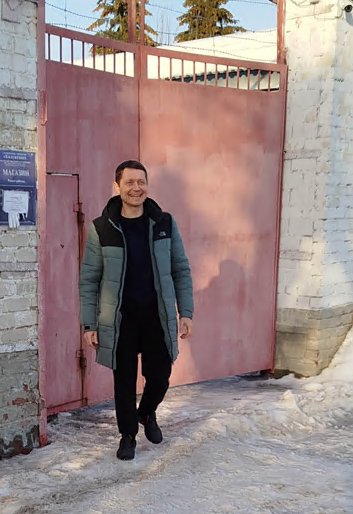
The Case of Pilshchikov in Cheboksary
Filter
- #
Judge of the Leninskiy District Court of Cheboksary Aleksandr Stepanov gives permission to search Albert Pilshchikov's home.
- #
A search is underway in the home of Albert Pilshchikov in Cheboksary.
- #
The senior investigator-criminalist of the FSB, Major of Justice D. V. Baranov, opened a criminal case against Pilshchikov. The believer is charged with organizing the activities of an extremist organization for participating in peaceful meetings for worship of Jehovah's Witnesses.
- #
Judge of the Moskovsky District Court of Cheboksary Sergey Kuryshev chooses a restriction measure against Pilshchikov in the form of detention. The investigation considers meeting friends to read the Bible and discuss Bible teachings "criminal activity."
- #
Pilshchikov does not have a Bible, but he is supported by letters that come from caring people.
- #
The Supreme Court of the Chuvash Republic releases Albert Pilshchikov from the pre-trial detention center and places him under house arrest. He is required to wear an electronic tracking bracelet.

- #
The case is submitted to the Novocheboksarsk City Court of the Chuvash Republic for consideration on the merits.
- #
At the first hearing, the prosecutor motions for closed proceedings during the presentation of evidence by the prosecution; the court grants the motion. The defense files a motion to disqualify Judge Yekaterina Ogoreltseva. She proceeds to the deliberation room for more than 30 minutes and denies the motion to disqualify.
- #
Several hearings are devoted to examining the case materials. The court reviews many hours of video recordings of religious meetings attended by Albert Pilshchikov and his fellow believers. The content of the recordings consists of joint reading of the Bible, singing, and discussing religious texts about love for one's neighbor and family relationships. More than 50 people come to the courthouse to support the believer.
- #
The prosecution announces a change in the order of presenting its evidence and files a motion to interrogate a secret witness. Pilshchikov and the defense object; the judge grants the prosecutor's motion.
The defense requests the disclosure of the witness's identity. The judge retires to the deliberation room for almost 30 minutes and, upon returning, denies the defense's motions.
After several technical breaks related to establishing a connection, the interrogation of the secret witness begins. The judge repeatedly dismisses questions posed by Albert Pilshchikov. The defense's repeated motion to disclose the witness's identity is denied.
The witness states that he met Jehovah's Witnesses in the spring of 2017, studied the Bible with them, and later underwent water baptism. He stopped associating with Jehovah's Witnesses after 2020, fearing that a search might also be conducted at his home. The witness's testimony at times reproduces the text of the protocol of the preliminary interrogation almost verbatim.
To questions from the defense, the witness responds evasively and without substance.
- #
The defense files a motion to disqualify Judge Ogoreltseva, but she denies it. Interrogation of the witness for the prosecution, Afanasyev, an officer of the Center for Counteracting Extremism, takes place.
- #
At the request of the defense, the court moves to open hearing mode.
- #
Albert gives testimony. He states that establishing his religious affiliation does not confirm that a crime was committed. Albert notes that the expert studies conducted in the case did not find any signs of extremism in his words.
The believer comments: "In his testimony, the secret witness 'Nikolaev' said several times that I allegedly frightened him with fiery hell. But that is not true." As evidence, Albert cites a quote from the religious expert conclusion: "The teachings of Jehovah's Witnesses deny the immortality of the soul and torment after death."
About 70 people come to support Albert; 25 of them are allowed into the courtroom.
- #